




#Amorepacific:log
2026.07.03
0 LIKE
11 VIEW
-
-
- 메일 공유
-
https://dev.stories.amorepacific.com/en/amorepacific-when-the-beauty-we-wear-meets-renewable-electricity-amorepacifics-re100-journey
When the ‘Beauty’ We Wear Meets Renewable Electricity: Amorepacific’s RE100 Journey
ESG, Here and Now #2
Columnist
Haengjin Lee Sustainability Management Center
Editor's Note
We'll come clean. We are complete ESG obsessives. We're the kind of people whose eyes light up the moment someone mentions carbon footprints in a meeting, and who have 'aha' moments reading sustainability reports. After hearing "okay, but what does that actually mean?" one too many times, we decided to write it all down. From the life and death of a cosmetics product to the survival story of a reindeer, we've put together a collection of ESG stories that might catch you off guard. By the time you're done reading, you might find yourself one of us. "ESG, Here and Now" comes out every other month. Welcome to the club!
Intro. The 'Sustainable Question' Waiting on Your Vanity Every Morning
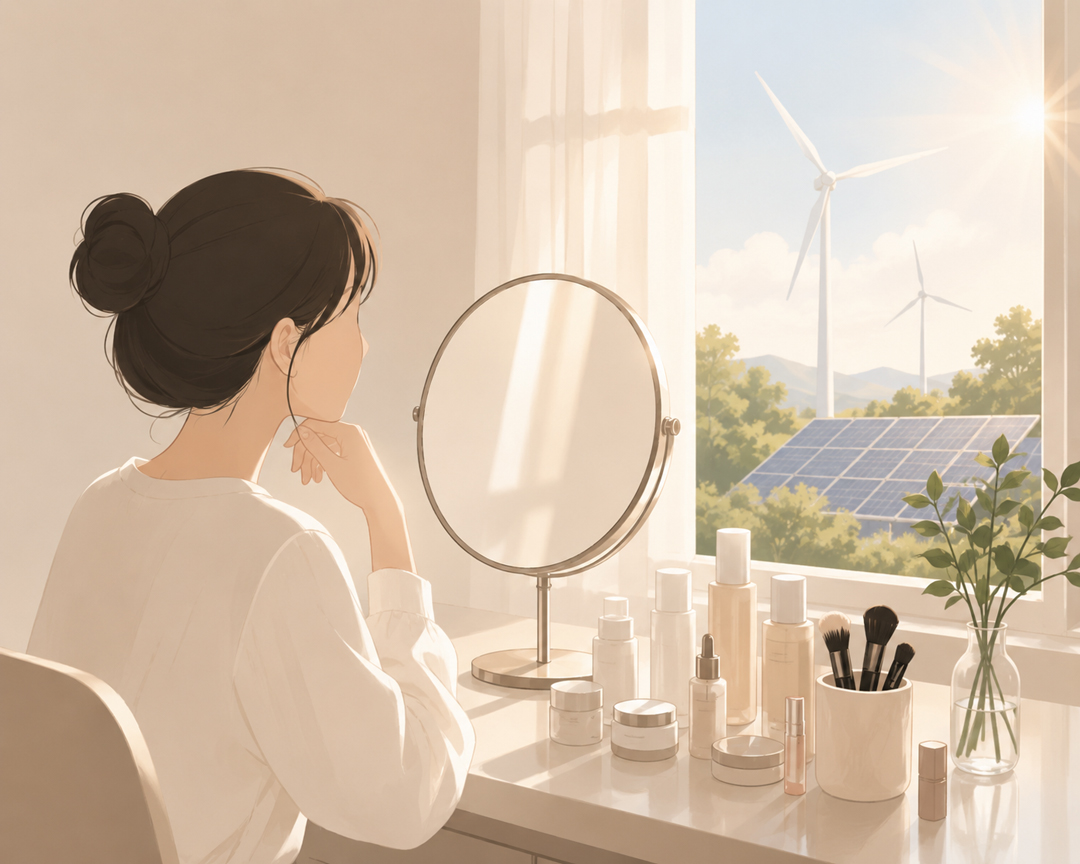
Source: AI-generated image
What goes through your mind each morning as you sit down at your vanity? "Is my skin doing okay today?" Or, "Will this cream leave my skin a little more hydrated?" Most of us are probably thinking about the beauty and health of our own skin.
But have you ever wondered about something like this: "Behind the skincare I apply every day and the vibrant lipstick I wear, what does the 'energy' working busily behind the scenes actually look like?" Or, "Was this cream made with electricity from coal burned into acrid smoke, or with electricity born of warm sunlight and cool wind?"
Amorepacific has long asked itself this very question. Our promise, We Make A MORE Beautiful World, could never stop at simply formulating cosmetics with good ingredients. We believed that true 'beauty' is only complete when everything, from the containers our products come in to the lights inside the factories that make them, runs on renewable power.
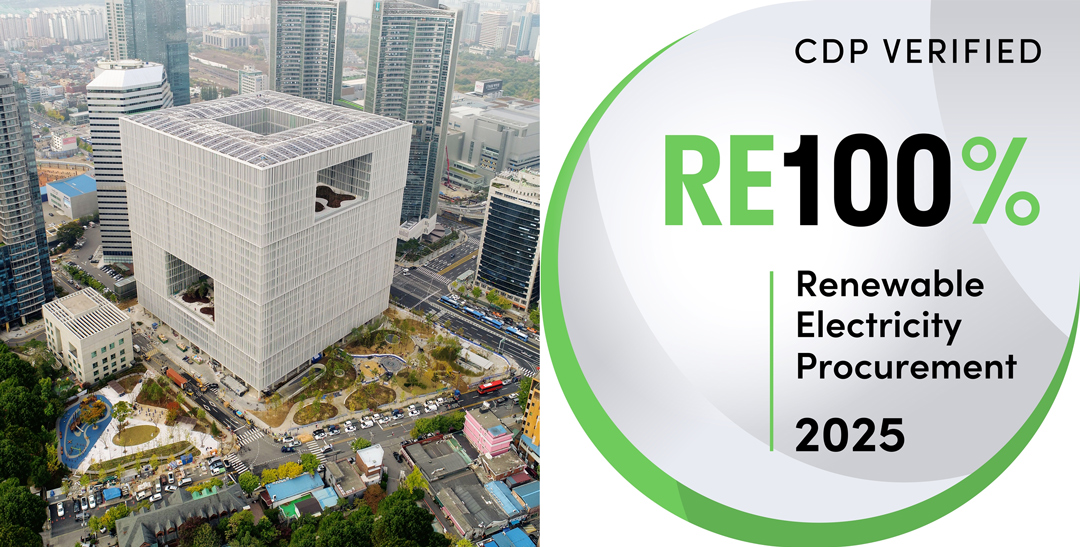
And in 2025, Amorepacific finally achieved 'RE100': converting 100% of the electricity used at every business site worldwide to renewable energy. The beginning of this enormous journey and its most grueling middle stretch were built on a management philosophy committed to making the world beautiful and on the dedicated sweat of countless colleagues who came before us. As the next runner to set the final piece of the RE100 puzzle in place on that solid foundation, I'd like to walk you through the story of Amorepacific and the people who, together, blazed a trail no one had walked before.
1. What Is RE100, and Why Bother with Renewable Energy?

Source: RE100 Information Platform
RE100, the term you occasionally come across in the news, stands for "Renewable Electricity 100%." It's a global campaign in which companies commit to powering 100% of the electricity they use to make products and run their operations with renewable energy from natural sources, such as sunlight (solar) and wind, rather than fossil fuels. Think of it as the corporate equivalent of cutting out instant food entirely and switching to a 100% organic, whole-food diet for the sake of your health.
At this point, a question naturally arises: isn't electricity just electricity? Why does using solar and wind specifically reduce carbon emissions? To unravel this mystery, we need to look into the 'secret of energy's birth.'
Fossil Fuels: Cracking Open the Earth's 'Piggy Bank'
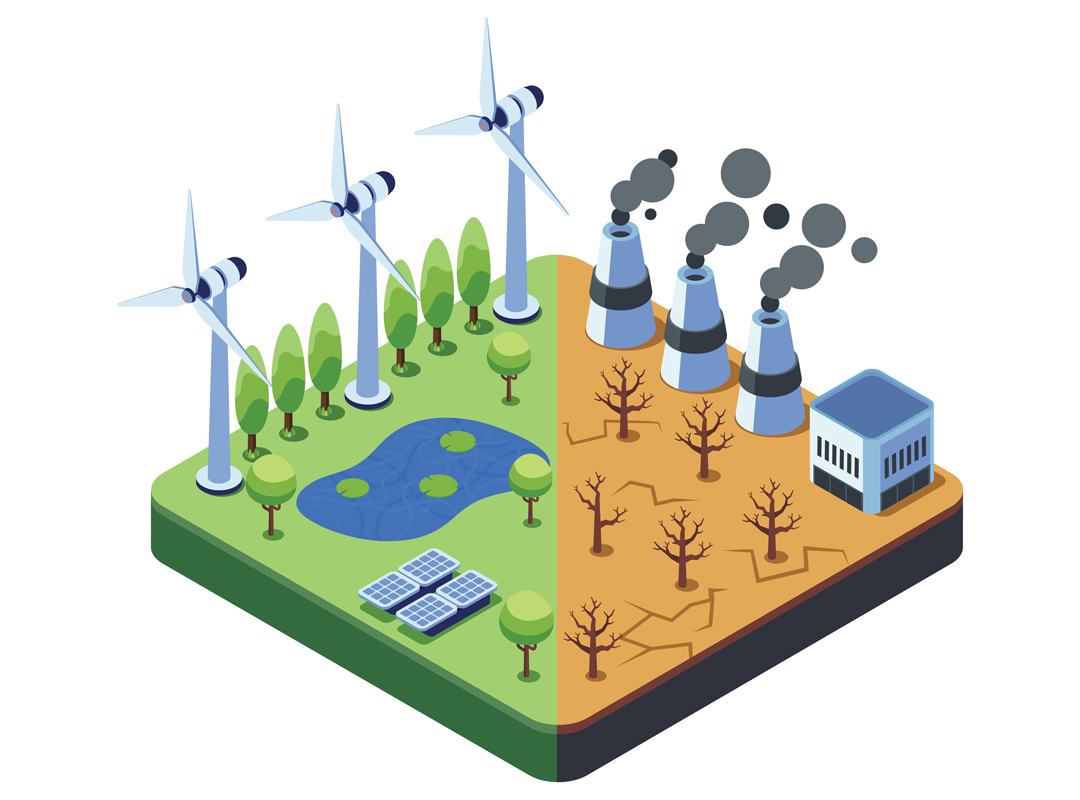
Fossil fuels like coal and oil are what's left when plants and animals from hundreds of millions of years ago were buried underground and hardened over time. Scientifically speaking, the 'carbon' that those ancient living things once held was sealed deep in the earth. From the planet's point of view, it had safely tucked that carbon away in an underground 'carbon piggy bank.'
The problem is that humans started cracking open that piggy bank to pull out coal and oil and burn them for electricity. The instant fossil fuels burn, carbon that has slept underground for hundreds of millions of years rises into the sky as greenhouse gas, all at once. These gases wrap around the Earth's surface like a thick plastic greenhouse, triggering climate crises such as abnormal heat and torrential rain. It's the main reason we hear the same tired news every year that this summer will be hotter than the last.
Renewable Energy: Nature's Endless Cycle
Sunlight and wind, by contrast, don't burn anything to generate energy. With nothing being burned, no greenhouse gases are released into the atmosphere. And while coal disappears once it's used, sunlight and wind are an infinite, circulating form of energy: use them today, and they're back again tomorrow.
In the end, switching the power we use from coal to renewable energy is the surest way to cut off, at the source, what causes greenhouse gases to be pumped into the sky. That's why renewable energy is considered one of the key levers of 'carbon neutrality': making the amount of carbon emitted equal to the amount absorbed, so that net emissions are zero.
Back in 2021, Amorepacific became the first company in Korea's beauty industry to officially join RE100, declaring to the world, "We will achieve 100% renewable energy by 2030." That we were able to deliver on this goal in 2025 — a full five years ahead of our own pledge — is entirely thanks to the colleagues who quietly put in the legwork on the ground.
Source: gettyimagesBank
2. Just as Important as Buying Renewable Energy: Going on an 'Energy Diet' for the Planet
Before we get into how we actually procured renewable energy, there's one thing worth flagging. No matter how much healthy, organic produce you buy, you can't call it a truly healthy life if you're overeating every day or throwing away mountains of leftover food. Energy works the same way. No matter how much renewable energy a company secures, if its factories and offices are squandering electricity, it's like pouring water into a leaking jar. So alongside sourcing renewable energy well, Amorepacific focused just as hard on an 'energy diet,' cutting down the sheer amount of electricity it uses in the first place. We decided to become 'light eaters' of energy.
Scraping the Bowl Clean: Hunting Down Every Leaking Watt
To do this, energy managers across the company combed through every corner, hunting down wasted energy and fixing it. The office building at Amore Beauty Park used to run a massive boiler to generate hot steam to supply hot water. We switched this to an electric system that heats only as much as is actually needed, and optimized the capacity of the hot-water equipment. At Daejeon Hair & Beauty Center, air conditioners and other equipment were previously managed on a unit-by-unit basis; we replaced this with a centralized control system. As a result, in December 2025, we achieved the distinction of being named an Energy Champion site under the Korea Energy Agency's 'Voluntary Energy Efficiency Target Program.'
Not because regulation or obligation demanded it, but because the company chose, on its own, to conserve and streamline its energy use, we've succeeded year after year in cutting back enormous volumes of greenhouse gas through what amounts to a genuine change in our energy 'constitution,' not a quick fix. The secret behind a transition that's solid down to the bone, rather than just for show, lies in the relentless effort of these energy managers.
3. Reaching 100% Renewable Energy on Korean Soil: A Challenge That Looked Reckless
When we first joined RE100, the reaction around us, honestly, was more concern than encouragement. People questioned why a beauty company, not exactly a heavy-chemical manufacturer burning through energy by the ton, was in such a rush and doubted whether it was even achievable given how underdeveloped Korea's renewable energy infrastructure was. Korea, in fact, is a difficult environment for building large-scale solar or wind facilities, given its small landmass and mountainous terrain. On top of that, the system was only getting off the ground, so even if a company wanted to buy renewable electricity in bulk, there wasn't really a market in place to allow it. It was a bit like declaring you'd switch to a 100% organic diet when there wasn't a single organic vegetable on the supermarket shelf.
First Step: Starting With Our Own Rooftop
The first thing we could do was generate our own power. We began laying solar panels in earnest on unused space such as rooftops and parking lots at 'Amore Beauty Park' in Osan, Gyeonggi-do, the site where products like Sulwhasoo and LANEIGE are born. Back then, though, solar equipment cost far more than it does today, and simply reporting an initial investment running into the hundreds of millions of won to management, finding a vendor, and executing it all within a short window was, in itself, a heavy burden. But Amorepacific started anyway.
An even bigger trial came next. During the day, the renewable electricity our solar panels generated sometimes exceeded what the factory was even using, and solar power kept being produced even on weekends, when the factory wasn't running much. To avoid wasting that surplus and use it at night instead, we incurred considerable expense installing an ESS (Energy Storage System), a large-scale battery system. Not long after, though, a string of large ESS fire accidents broke out across the country. For safety's sake, our own factory's ESS had to be shut down completely for a while. It was a frustrating stretch: an expensive energy reservoir we'd invested so much in, sitting right in front of us, unusable.
Abandoning the storage system altogether was discussed, but after extensive deliberation and on-the-ground technical review, we decided to relocate and rebuild the existing facility above ground while investing additional funds to eliminate the fire risk at its source and raise safety standards. Thanks to that, the Osan plant no longer wastes its surplus solar power today; it's stored safely and put to use.
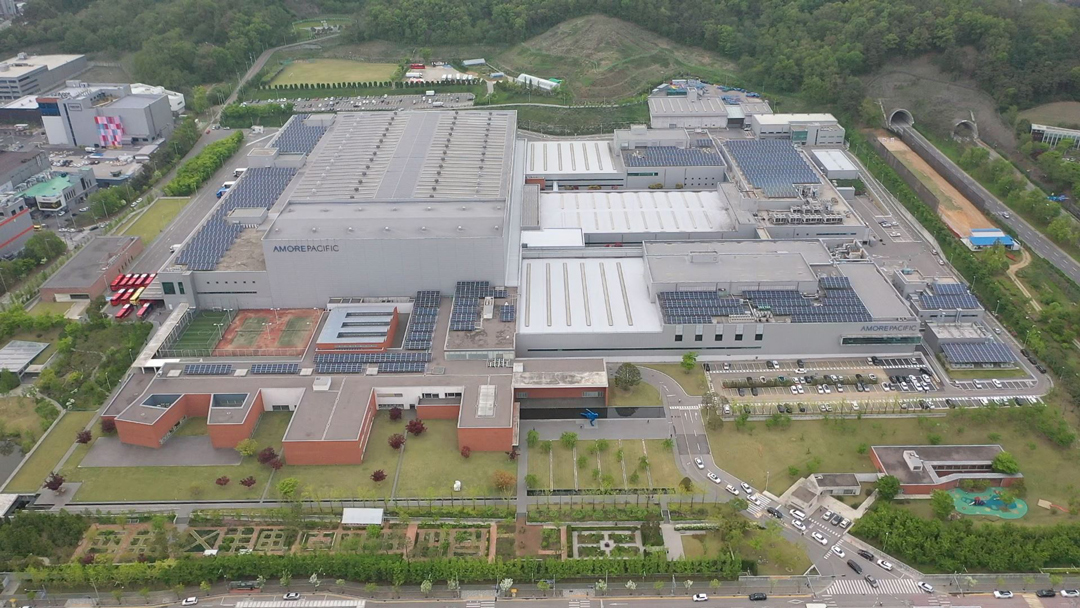
View of Amore Beauty Park, Osan
Second Step: Opening a Path No One in Korea Had Taken (Power Purchase Agreements, PPAs)
But the solar panels on our rooftops alone couldn't meet the enormous electricity demand of all our business sites, so we needed to buy large volumes of clean electricity from outside sources. Here, too, we hit a wall. At the time, Korea's electricity market was structured so that electricity could only be bought through a single, state-designated entity, Korea Electric Power Corporation. It was a bit like having exactly one state-run store in your neighborhood, with a rule that every resident and every business could buy only from that store, and nowhere else.
The trouble was that the electricity this store sold was 'general electricity,' like a pre-mixed meal kit blending coal, oil, nuclear, and everything else. We wanted to handpick only the 'renewable electricity,' like organic vegetables, and buy it in bulk, but the store's system at the time made that impossible. And going directly to the farms growing those organic vegetables, that is, the renewable energy plants, to propose a direct deal wasn't an option either, since bypassing the store for direct trade was illegal. Since no one had ever done a direct deal, it was uncharted territory: no laws, no rules, no accounting method for how to issue a receipt or settle payment.
So we went knocking, tirelessly, on the doors of government ministries and power plants alike. We kept proposing and persuading: "Please change the rules so companies can contract directly with farms and buy organic vegetables in bulk." Eventually, a law was put in place allowing companies and power plants to trade electricity directly, and Amorepacific, as if it had been waiting for exactly this moment, signed a direct deal known as 'Korea's First Direct PPA (Power Purchase Agreement),' followed soon after by a Third-Party PPA as well. It was a moment when we watched the steps we took become Korea's new standard.
Third Step: Jeju's Wind, Its Villagers, and a Story of Shared Growth with Amorepacific
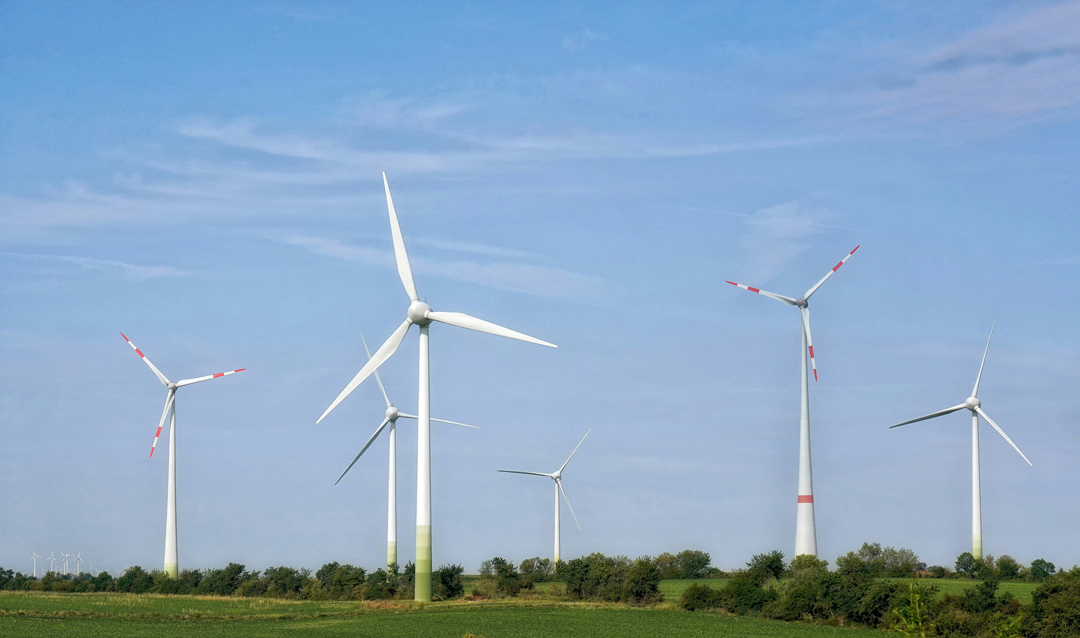
I'd like to share one warm story from Amorepacific's RE100 journey: our connection with Bukchon-ri, a village on Jeju Island. Amorepacific and Jeju share a deep bond because the precious raw materials our nature-based brands rely on, green tea, camellia, and more, all grow on Jeju soil. We wanted to repay Jeju for that debt through climate action. So we introduced Korea's first 'Virtual Power Purchase Agreement (VPPA),' an innovative approach, and joined hands with a wind farm run by the residents of Bukchon-ri on Jeju: Bukchon Seomo Wind Power.
A Promise to Share the Risk of Market Ups and Downs
The residents of Bukchon-ri on Jeju pooled their resources to build an impressive wind farm that harnesses the sea breeze to generate electricity. But there was a major problem: 'market price volatility.' It's hard for an everyday electricity consumer to feel this directly, but the wholesale price of electricity swings just as sharply, from one moment to the next, as the wholesale price of vegetables. Just as a sudden crash in vegetable prices can devastate a farming household, a sudden drop in the electricity market price could leave villagers running a small power plant facing major losses and an unstable livelihood.
So, to let the villagers keep generating renewable electricity, Amorepacific stepped in to shoulder that risk for them, through a fixed-price contract for differences, a kind of insurance policy. Here's how it works. The Bukchon-ri residents first sell their electricity to a store in Jeju. Amorepacific then buys that electricity from the store, and if the price crashes, we cover the difference up to the fixed price we'd promised. In exchange for reducing the residents' potential losses, we receive Renewable Energy Certificates (RECs) under a 20-year long-term contract.
Because Amorepacific, as a company with far more stability and creditworthiness than any individual, promised to buy electricity at a stable price for 20 years, banks recognized a secured long-term revenue stream and felt confident lending business funds to the small power plant. This meant that, however wildly prices fluctuated, the villagers could keep farming wind-powered electricity without fear of loss. We were the first in Korea to introduce an RE100 implementation model in which a company shares market risk with local residents for mutual benefit.
Source: Unsplash
The power purchase agreements we've covered so far — direct PPAs, Third-Party PPAs, and VPPAs — come in a wide variety of forms with names that sound complicated, but the virtuous cycle behind them is much the same. Becoming a long-term buyer of clean electricity at a fixed price signals to developers, "please build more solar farms," and to banks, "please invest more in renewable power plant projects." Once Amorepacific led the way, many other companies followed suit, and that became a fresh jolt of energy for Korea's once-frozen renewable energy development sector.
And because we were the first to run into these walls and lay the groundwork for trading rules and accounting standards, countless companies in Korea can now buy renewable energy more easily and safely. The small trail we cut through has become the spark that lit Korea's RE100 market for renewable energy.
4. Achieving RE100 in 2025, and the Real 'New Beauty' Beyond It
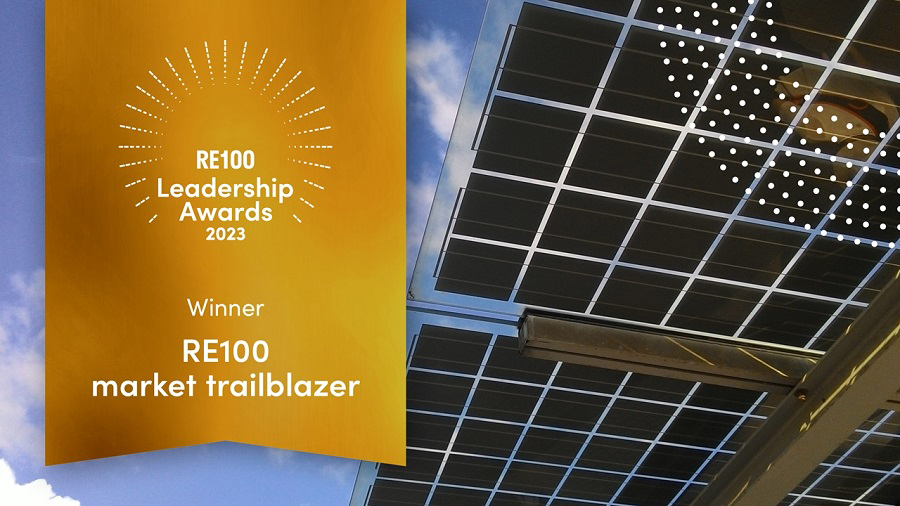
In 2025, Amorepacific succeeded in converting the electricity used across all its business sites, at home and abroad (offices, factories, labs, branches, and more), to renewable energy. As a result, we earned an 'A' grade, the highest rating, in both the climate change and water security categories from CDP (Carbon Disclosure Project), the global ESG evaluation body: a mark of global leadership reserved for only about 2% of the roughly 23,000 companies assessed worldwide. Back in 2023, we'd also had the honor of receiving the 'Market Trailblazer Award' from The Climate Group, the nonprofit organization behind the global RE100 initiative, beating out companies from around the world.
Achieving RE100: Not the Finish Line, but a More Rigorous New Beginning
But achieving RE100 isn't the finish line; it's a new beginning. Our summers keep getting hotter every year, and wildfires keep raging fiercely around the world; we can't afford to be satisfied with what we've done so far. The climate crisis we face now is asking something deeper and more demanding of us: a genuine renewable energy transition. Upgrading our portfolio toward 'Additionality,' contracts that actually encourage new solar and wind farms to be built on the ground, is, in our view, what a truly meaningful renewable energy transition requires of us.
Of course, this isn't an easy road. Finding renewable energy facilities that precisely match our real-time electricity use and structuring contracts that interlock like gears at the most efficient capacity still face plenty of obstacles in policy and market conditions. But we intend to keep working through these constraints one by one, through ongoing discussions and proactive proposals with government ministries and power generation companies.
One More Step, Still Far Ahead
As someone working on the front lines, let me also share another topic that's been on my mind lately: implementing real-time renewable power matching, also known as '24/7 Carbon-Free' energy. It's a concept recently being discussed as RE100's next destination. The current version of RE100, frankly, works by matching the total electricity we use over a year to the total renewable energy we purchase, so that the two add up to "100% annually." But to put it bluntly, that leaves a real limitation: on pitch-dark nights with no sunlight, or on days when the wind dies down, we still have no choice but to draw on fossil-fuel electricity.
That's why there's growing talk of a need to go beyond annual settlement and build a system that matches renewable energy in real time: every hour of every day, all year round, at the exact moment we're using electricity. Wouldn't it be wonderful to use truly 'real-time decarbonized energy,' sending surplus daytime solar power into the night, storing wind energy the instant it's generated, and optimizing it all? We're only taking it one step at a time for now, but I hope that someday we'll crack this challenge beautifully enough that you can sit down at your vanity each morning with complete peace of mind.
Source: The Climate Group
Change Across the Supply Chain (Scope 3)
Making a single cosmetic product requires help from countless partner companies: the printer that makes the box, the factory that makes the container, the suppliers that provide raw materials. The world won't change just because Amorepacific alone eats a 100% organic diet. That's why we provide technical and financial support to help our valued partner companies reduce their greenhouse gas emissions and adopt eco-friendly facilities too. Reducing the carbon footprint across the entire process by which a product comes into being, across the whole supply chain, is at the heart of our commitment, the '2030 A MORE Beautiful Promise.'
Outro
Let's revisit the question we started with. The Amorepacific creams and serums you meet each morning are no longer just cosmetics — they're products made and packaged with care, using electricity born of Jeju's cool sea breeze and electricity born of sunlight pouring down on the rooftops of Amore Beauty Park.
What Amorepacific wants is straightforward: to build a solid structure that our customers can take part in climate action simply by choosing cosmetics made with renewable energy and standing behind that value. We want your purchases to become purchases with real value, purchases that, together, help build one more renewable energy plant in Korea and grow into a tremendous force for lowering the planet's temperature. We hope you'll continue to join us on this beautiful journey, with your warm interest and support. Thank you.
-
Like
0 -
Recommend
0 -
Thumbs up
0 -
Supporting
0 -
Want follow-up article
0
Array
(
)