




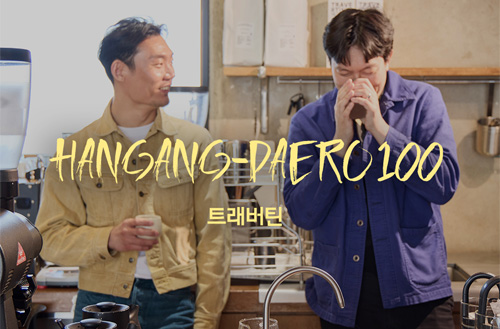
#Hangang-daero 100
2026.04.03
0 LIKE
85 VIEW
-
-
- 메일 공유
-
https://dev.stories.amorepacific.com/en/amorepacific-meeting-seungmok-lee-and-jongwon-kim-of-travertine
Meeting Seungmok Lee and Jongwon Kim of 'Travertine'
A Roastery Café on Hangang-daero, Built on Taste and Experience
Tucked into a narrow alley between the modern high-rises of Hangang-daero, a lane where every season arrives in full, is Travertine, a roastery café that takes coffee seriously. Housed in a weathered old building reimagined with a contemporary sensibility, this captivating space has been offering visitors a meaningful pause and a place to discover new tastes since 2018. Through a single good cup of coffee, Founder Seungmok Lee and Head of Operations Jongwon Kim hope to bring people and the neighborhood together and, much like Amorepacific has done, build a heritage entirely their own. Like travertine itself, a limestone whose cross-section holds every layer of time in beautiful relief, the café is a place where the tastes and experiences of its guests accumulate quietly, one cup at a time — and we went to see it for ourselves.
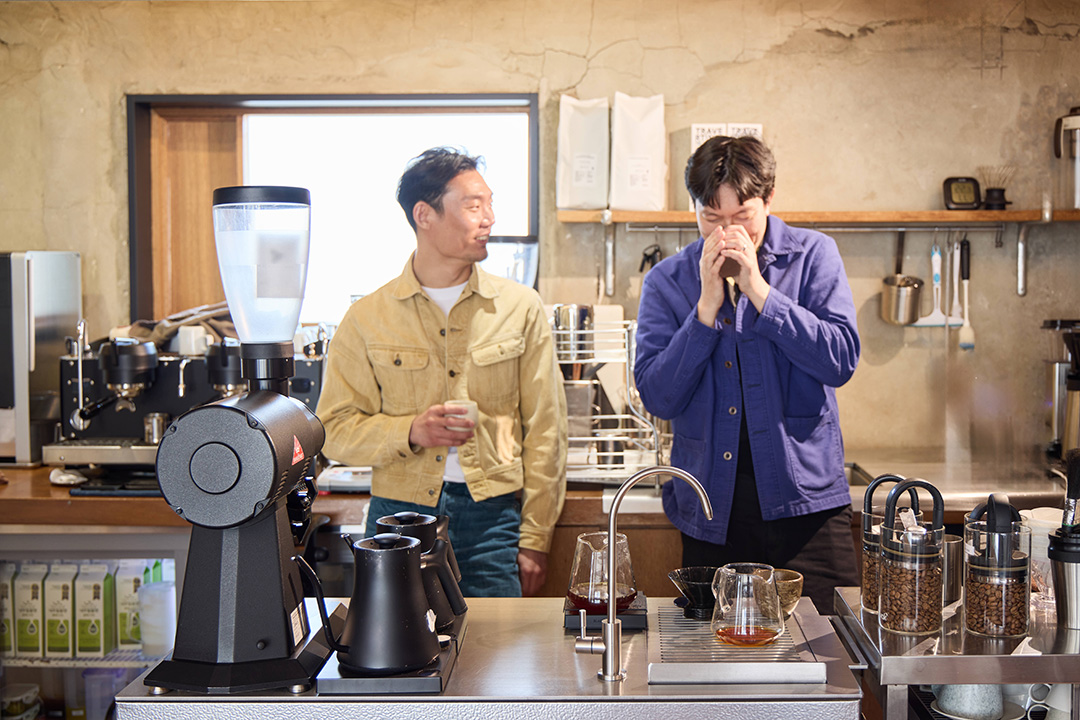
Would you start by introducing yourselves to our readers?
Seungmok Lee Great to meet you. I'm Seungmok Lee, Founder of Travertine. We opened in the early fall of 2018, starting with this Yongsan location. Since then, we've expanded to a second location in Hannam and a shop at Songdo Hyundai Premium Outlets. We also run Baton, a brunch café not far from here.
Jongwon Kim I came on board in February 2020. Seungmok and I had known each other back home for years (he's a few years my senior), and eventually we decided to build a team together. While he oversees the overall management and planning, my focus is on everything coffee: roasting and quality control across our locations.
You've been on Hangang-daero for quite a long time now. Of all the neighborhoods you could have chosen, what drew you to this particular alley?
Seungmok Lee Before starting the business, I worked at a coffee franchise company managing around 30 brands. I'd always loved coffee — I'd worked part-time jobs and spent years in the field long before that — but the corporate experience was where I really learned the nuts and bolts of running a coffee business. The more I learned, the more I wanted to build something beyond just a place that sells coffee: a fully realized brand that could genuinely mean something to people. Going independent felt like the natural next step.
My store development work took me all over Seoul, and I came to see that Hangang-daero had a remarkably unusual history. Right here is an alley that's been frozen in time for over 20 years, tied up in redevelopment limbo, and just across the street stand the gleaming headquarters of companies like Amorepacific. The contrast between the two was striking — and, to me, deeply appealing. What ultimately sealed it for this exact spot was the ginkgo tree out front, which is over a hundred years old. Finding a tree that size in the middle of Seoul felt extraordinary. I also loved the building itself, which still carries traces of traditional hanok architecture, and the completely unobstructed view from the entrance.
How did you come up with the name 'Travertine'?
Seungmok Lee At its core, coffee is a fruit. The outer appearance tells you very little: dig deeper, and what you find is something with an entirely different nature. Thinking about that quality, about what something truly is beneath the surface, led me to travertine, a type of limestone. When you look at a cross-section of the stone, you see these beautiful layers built up through countless years of sediment — layers that were once something else entirely, some other material in some other form. That idea is where the name came from. I wanted to make coffee that carries the care of its entire process all the way through to its essence. Travertine stone is also the primary interior finish in this original location, so the space and the brand share the same meaning.
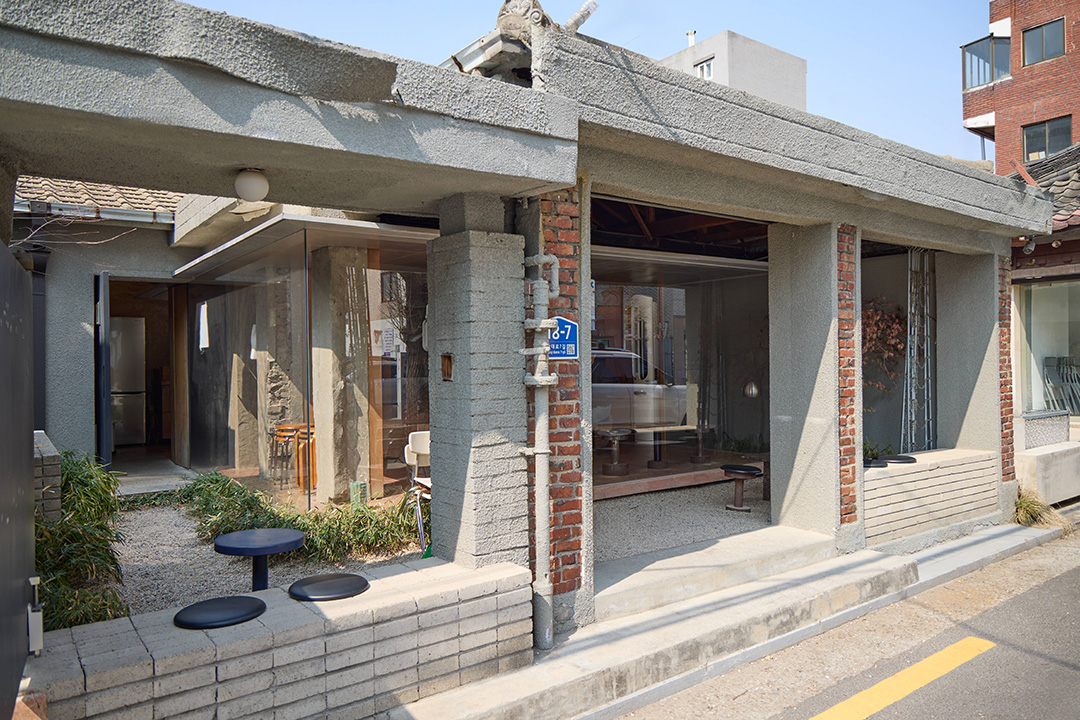
The concept behind the space is so distinctive — and with limestone as the interior finish.
Seungmok Lee I was reading Carl Sagan's 'Cosmos' while designing the space, so I had the universe very much in mind. I wanted the café, with its travertine floors, to feel like something that had crash-landed on Mars. Rather than chasing what was trendy, I wanted to create a space where the materials themselves do the talking: something that only grows more characterful as it ages and wears.
Jongwon Kim The view of the alley through those floor-to-ceiling windows does feel a bit like looking at Earth from another planet. I'm glad our customers seem to enjoy the space as much as we do./p>
In 2018, this alley wasn't the draw it is today. What was the atmosphere like when you first opened?
Seungmok Lee As you say, we were essentially the only café here before the area caught on. There were a few old restaurants, but none of the shops you see today. It was pretty bare. So I started pulling in friends from my hometown, Daegu. The restaurant next door, Hithai, is run by an old friend from back home. The udon shop that used to be next to us, long since closed, was actually a concept store called Reelee Store, and I was the one who talked that owner into giving Seoul a try. We spent four or five years like that, a cozy little community. We leaned on each other, had good times, but it was genuinely hard for all of us. Still, we got through it. I'd like to think I'm pretty good at holding on.
What was the hardest part?
Seungmok Lee In the early days, we had no clear marketing strategy, just a vague belief that if we did things right and with integrity, people would eventually find us. Social media wasn't what it is now, so we were counting entirely on word of mouth to bring in coffee lovers. We were fortunate that employees from Amorepacific and other nearby companies came in regularly, but the word never spread much beyond that. We went on like that for two or three years, and looking back, I think we enjoyed each day, even when it was hard.
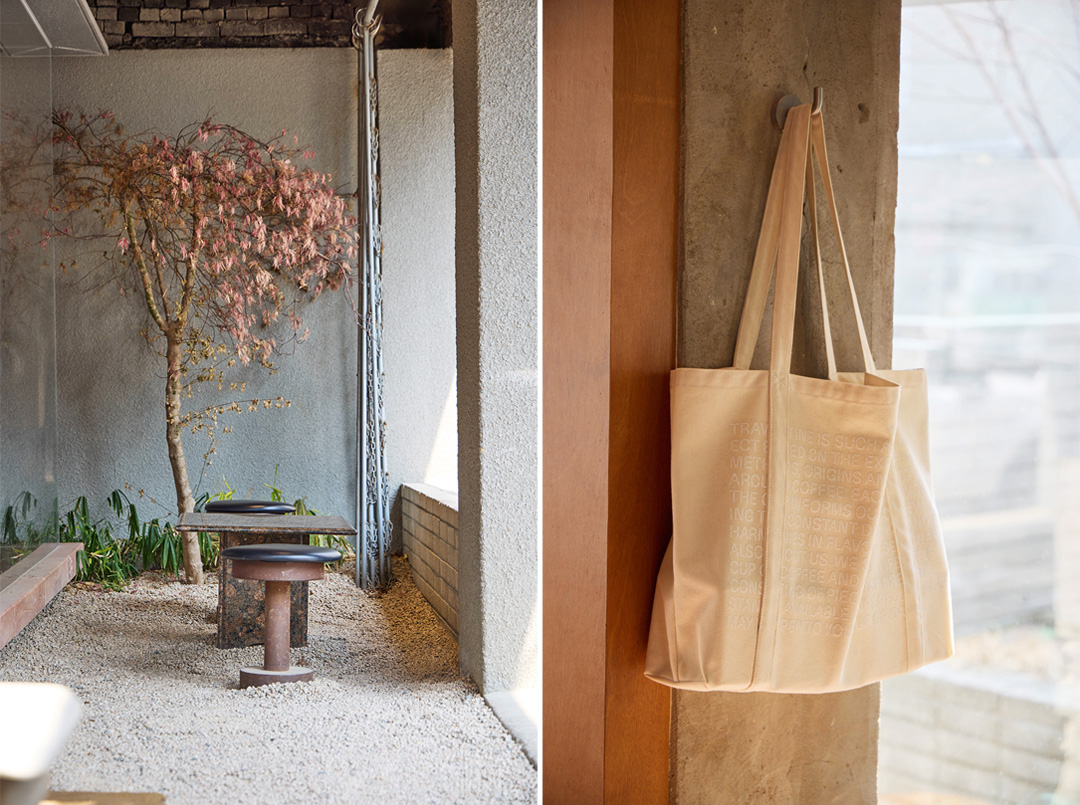
These days, Travertine is recognized as a genuinely conceptual space. Was there a turning point?
Seungmok Lee The biggest turning point came when we opened Baton, our brunch café, in early 2020. After running Travertine for about two years, I'd started to feel that relying on coffee alone would put a ceiling on how solid our revenue could be. Baton was the answer to that, a café where food and coffee could work together. As it happened, COVID hit two or three weeks before we were scheduled to open. We had no sense yet of how serious things would get, so, half in disbelief, we went ahead and opened as planned. Somehow it went viral, and for nearly a year, there was a line out the door every morning. Externally, it was one of the hardest periods imaginable, but Baton found its footing remarkably quickly. That experience was what made me see, in concrete terms, that building a solid structure around the Travertine brand had to be the priority going forward.
After reflecting on it, what did you decide needed strengthening?
Seungmok Lee Jongwon and I talk about this constantly, and our view is that F&B has become a total art form. What we do isn't high art by any stretch, but the process touches an enormous range of disciplines. You need the humanistic sensibility to articulate a brand philosophy, the visual instinct to create compelling spaces and products, and the analytical rigor to manage costs and labor down to the numbers — all of it, at once. What I've come to believe is that, beyond making great coffee, you need a comprehensive ability to connect every element organically, with the execution to back it up. That's also why Jongwon and I drew such clear lines around our respective roles. I used to want to do everything myself, and honestly thought I could. But carrying it all alone is a sure way to burn out fast. A brand isn't something you build by insisting, 'This is what we are.' What matters is how long people remember you. So I've been focused on building a structure where a well-matched team can share the load, rely on each other, and go the distance. Without that, I don't think you survive.
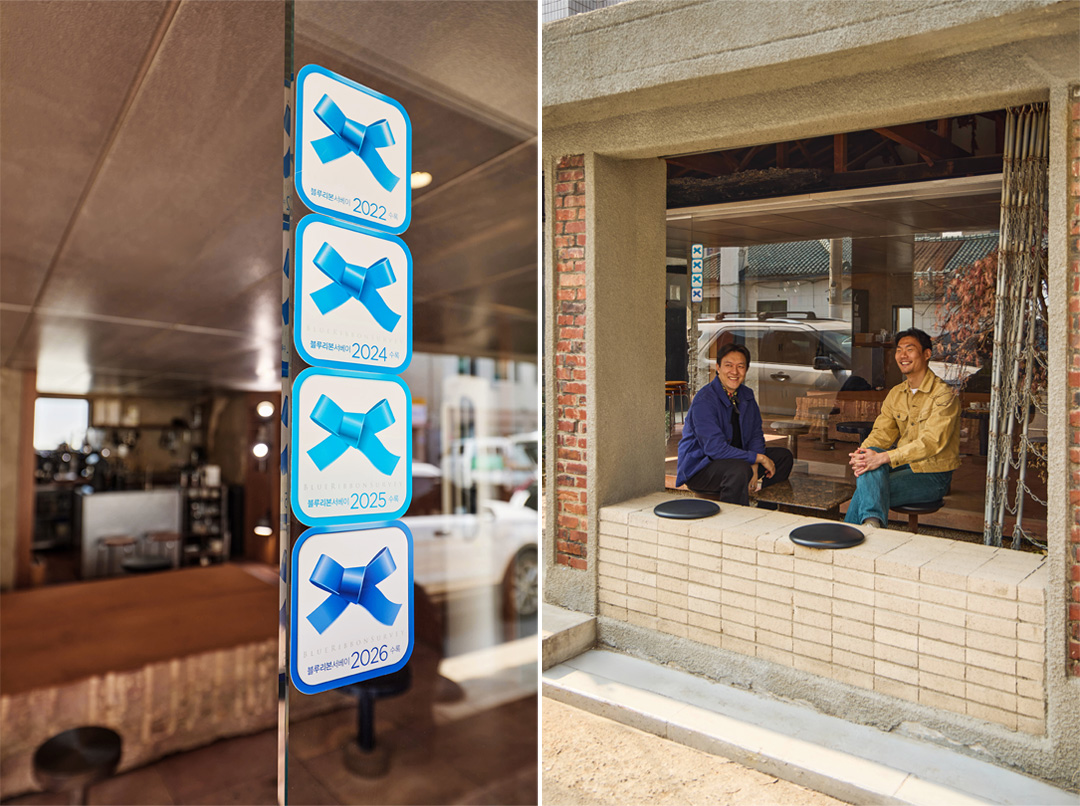
We understand that Seungmok handles the business side — what does Jongwon's role look like in practice?
Jongwon Kim Everything coffee, basically. To put it in my own words: I do whatever it takes to make a cup of coffee that gets people saying, 'Worth every penny,' 'That was truly delicious,' 'I feel good just having had that.' From sourcing green beans to roasting, coffee is my whole job, and all my energy goes into 'quality control,' keeping the standard consistent across every cup.
Seungmok Lee We didn't actually roast our own beans from the start. For about four years, we imported beans from La Cabra, a world-class Danish roastery. We were a small neighborhood café, but we didn't want to compromise on our standards: we wanted to be benchmarked against the best. Working to serve La Cabra's coffee well meant spending four or five years figuring out, hands-on, exactly how to brew it and how to talk about it with customers. We learned an enormous amount that way. Then, about two and a half years ago, we decided that if we were going to build this brand for the long term, we needed to be doing our own roasting, and Jongwon took it on.
Jongwon Kim Neither of us had ever roasted before. Honestly, my first reaction was to say no: it felt like too much. (laughs) But Seungmok said: you've drunk a mountain of great coffee over the years, so you know what good and bad tastes like. Your palate is the same as mine; we share the same sense of taste, so give it a try. That trust was enough. I started on that basis, and I've been doing my best to make the best coffee I can ever since.
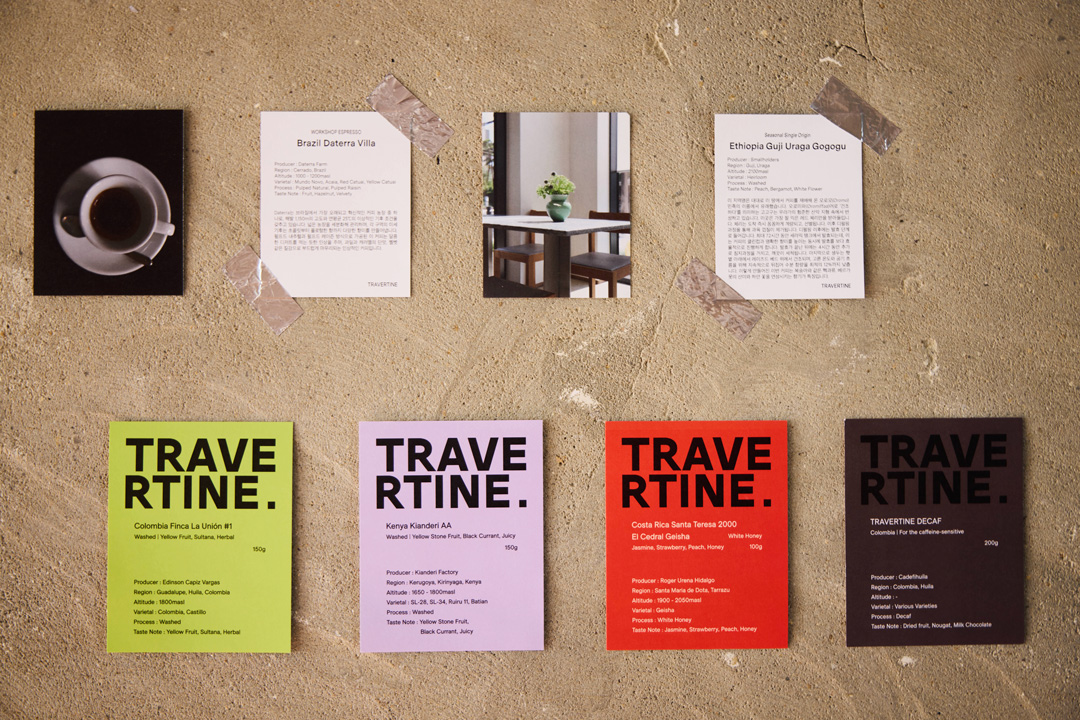
Starting to roast your own coffee right after COVID — that couldn't have been an easy call. Where were things, business-wise, at that point?
Seungmok Lee If we were going to build this brand for the long haul, moving into 'production' was eventually unavoidable: it was just the next stage of the journey. COVID itself was a relentless series of crises, one after another. When restrictions tightened, there were times we had no choice but to cut hours or, with a heavy heart, let people go. Around 2021, we used government support and bank loans to push through and open a department store location, an expansion that felt almost reckless at the time. There was never a moment to step back and ask whether we were in a crisis or an opportunity. We just kept solving the problem in front of us, and that's how we got here.
Making the switch from La Cabra beans to roasting your own was quite a shift. How did customers respond?
Seungmok Lee The funny thing is, most of our regular customers didn't really notice. (laughs) Among the serious coffee enthusiasts, though, opinions were definitely divided. Some of them had grown quite attached to how things used to taste.
Jongwon Kim What we were grateful for was a healthy dose of what you might call beginner's luck. I think because no one had any expectations of our roasting to begin with, people were willing to give us the benefit of the doubt. Now that expectations are so much higher, we work considerably harder than we used to to meet them.
Seungmok Lee Jongwon isn't really one for embellishment or spin. He literally told customers straight out, 'This is my first time roasting,' right from the start.
Jongwon Kim No reason to be anything but honest. My thinking was simple: it's my first time, but I'm charging money for it, so I'd better give it everything I've got.
Seungmok Lee Running a business, there's no shortage of bumps along the way. But when you have genuine confidence in what you're putting out, you find the strength to push through whatever comes and figure out a way forward. With the positive feedback building up one by one, I feel like we can comfortably make it to ten years and beyond.
Tell us about some of that positive feedback.
Seungmok Lee We've built a range of partnerships over the years, and now we have buyers coming from overseas for our beans, some purchasing for personal use, others for their own cafés. We ship globally: Taiwan, Singapore, Zurich, and New York (Manhattan). As it happens, right after this interview, I'm catching an evening flight to Australia. Melbourne is one of the great coffee cities in the world, and we've been invited to an event there as one of a small number of Korean roasteries. It's a real opportunity to introduce Travertine's coffee to a serious coffee crowd.
What's your focus when it comes to the roasting itself?
Jongwon Kim To put it as simply as possible, I'm aiming for 'clean coffee with a long finish.' After you drink it, I want the aroma and texture that linger in your mouth to stay with you in a way that feels purely pleasant, nothing off or heavy. It goes down smoothly without any astringency, and then a pleasant aroma blooms at the back of the throat.
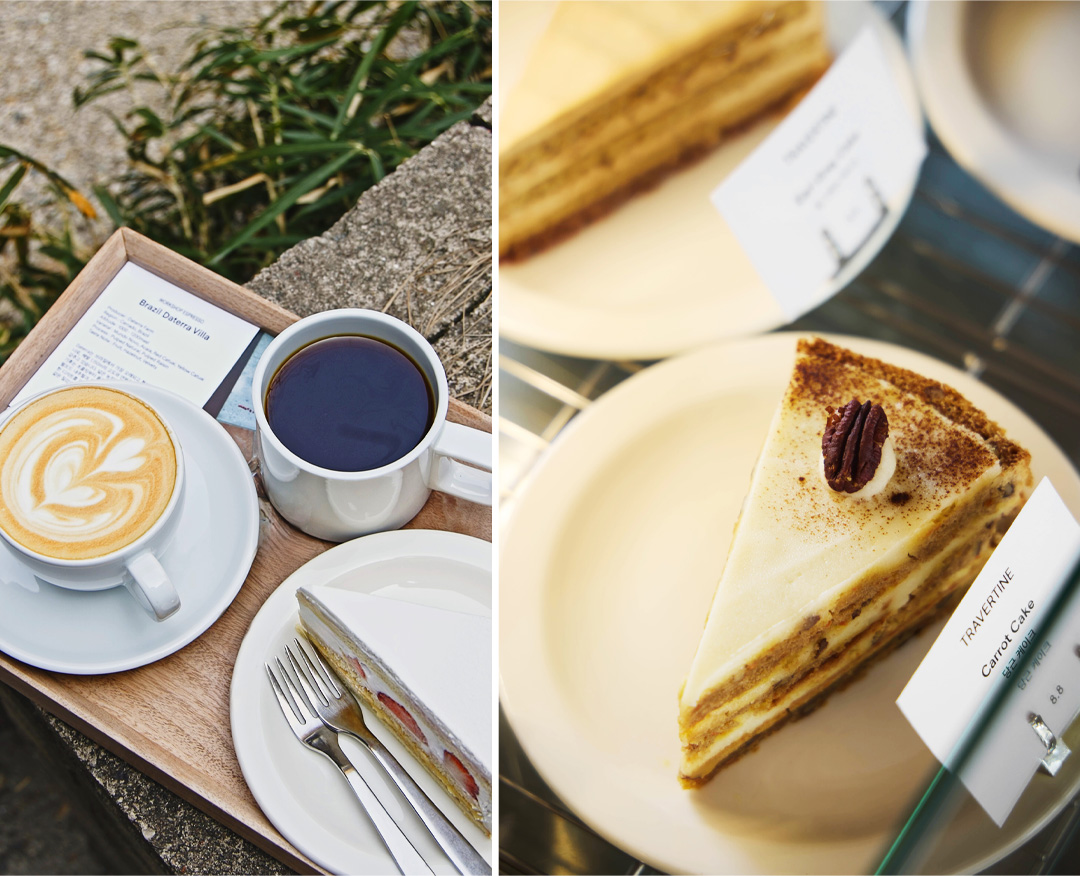
If you had to recommend one thing to try at Travertine, what would it be?
Jongwon Kim Filter coffee (hand-drip), without question. Because we select our green beans so carefully and roast them in-house, it's where the individual character of each bean comes through most clearly. There's a real pleasure in tasting your way through them, discovering whether you're drawn to bright acidity or a sweeter profile, and finding out what you actually like.
Seungmok Lee For those who want to experience the coffee itself, filter coffee is the way to go. For guests who are here more for the space and the atmosphere, I'd point them toward a latte or one of our signature drinks made with our own blended milk. A lot of people come in through that door and end up falling in love with single-origin coffee before they know it.
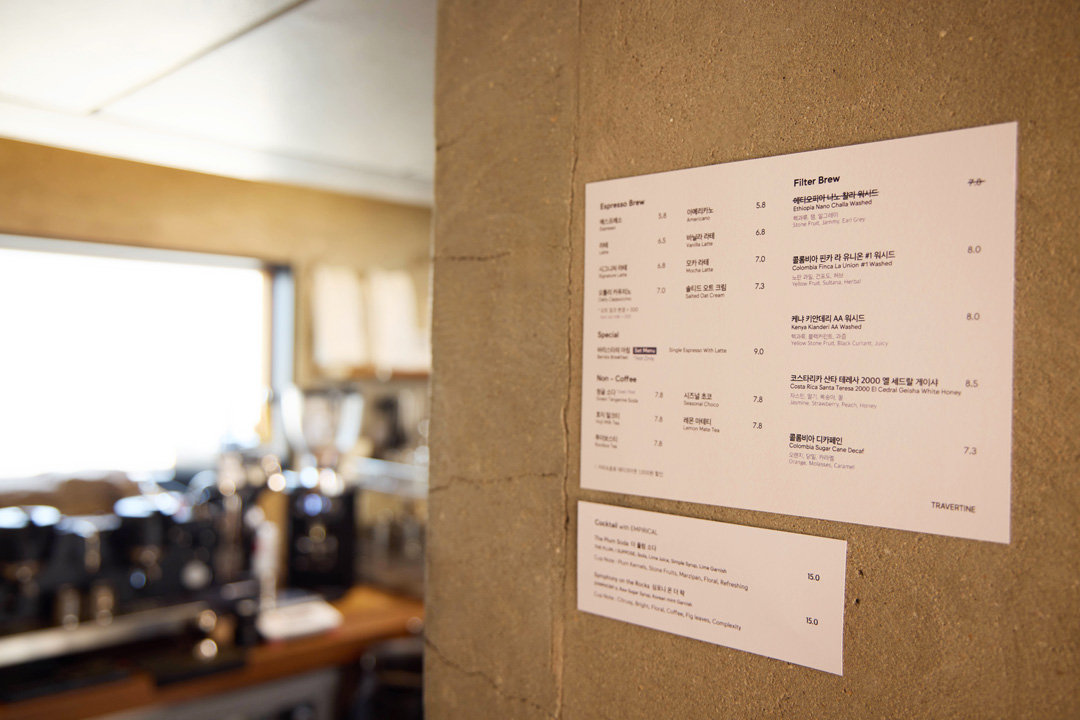
You've watched over this alley for a long time. Are you feeling the changes in the neighborhood lately?
Seungmok Lee Gentrification has hit hard over the past year or two. The market is polarizing: the places that are struggling are really struggling, and the small, characterful shops are disappearing one by one. It feels like we've reached a point where, without serious capital or compelling content, survival is a real challenge.
What do you think has allowed Travertine to keep growing in that environment?
Seungmok Lee Our team's approach is what I'd call flexible resilience, sometimes going deeper, sometimes reaching wider, riding out the changes as they come. We've had our difficult stretches, and there are moments when 'should we just stop?' crosses your mind. But the reasons to keep going always outweigh the reasons to quit. The revenue is there, we have a team that believes in what we're building, and above all, we have our customers' feedback. All those years of pushing through by finding reasons not to give up, I think that, in the end, is what growth looks like.
You've been a neighbor of Amorepacific for a long time. What does Amorepacific mean to Travertine?
Seungmok Lee The building alone is extraordinary, but beyond that, Amorepacific is the backbone and symbol of the Korean beauty industry. The way they continue to push into global markets while holding on to their heritage is something I truly admire. We're on a completely different scale, but I often think about wanting Travertine to carry that same quality. The fact that a company of that size still makes the effort to connect with the local community, build public spaces, and collaborate with the neighborhood has been a real source of inspiration for those of us building something from the ground up.
Finally, is there a piece of customer feedback that has stayed with you?
Jongwon Kim One morning, I was conducting a cupping session to check quality when a middle-aged man approached and started talking to me. He said he didn't want to interrupt, but that there was something he really needed to say. He told me that it was only through Travertine that he'd first discovered coffee could have an aroma, that it was here he'd learned what coffee actually tastes like. He said his thank-yous and left, and I was so moved. The feeling stayed with me for days. It's a reminder of why we pour so much into what we do, and I hope more and more people get to experience it.
Seungmok Lee For me, the one that means the most is hearing someone say, “When I think of Yongsan, Travertine is the first thing that comes to mind.” For a team that cares so much about carrying on the heritage of this neighborhood, there's no higher compliment. Ten years from now, I hope we're still right here in this spot, adding a little something good to your everyday life. Please keep coming back.

Information
Travertine
- Address: 18-7 Hangang-daero 7-gil, Yongsan-gu, Seoul
- Hours: 11:00–20:30
- Menu: Latte 6,500 won / Americano 5,800 won
"Amorepacific Local Community Project: The Heritage of Hangang-daero 100"
Yongsan is the beating heart of K-beauty's global rise. Through Amorepacific's lens, we document the storied commercial district and living culture of Hangang-daero — the roots that gave rise to it all.
A journey of growing together with local small businesses to nurture a vibrant beauty ecosystem. Discover the singular heritage shaped by the passion of the neighbors at 100 Hangang-daero.
-
Like
0 -
Recommend
0 -
Thumbs up
0 -
Supporting
0 -
Want follow-up article
0
Related content
See more
Array
(
)